🌿 GROWPlantWell – Nurture Nature, Transform Your Space 🌿
🌽 Maize Hybrid Development and Seed Production
Learn how single-cross maize hybrids are developed and how quality hybrid seed is produced, from inbred lines to certified seed.
Rashid Saleem
1/29/20263 min read
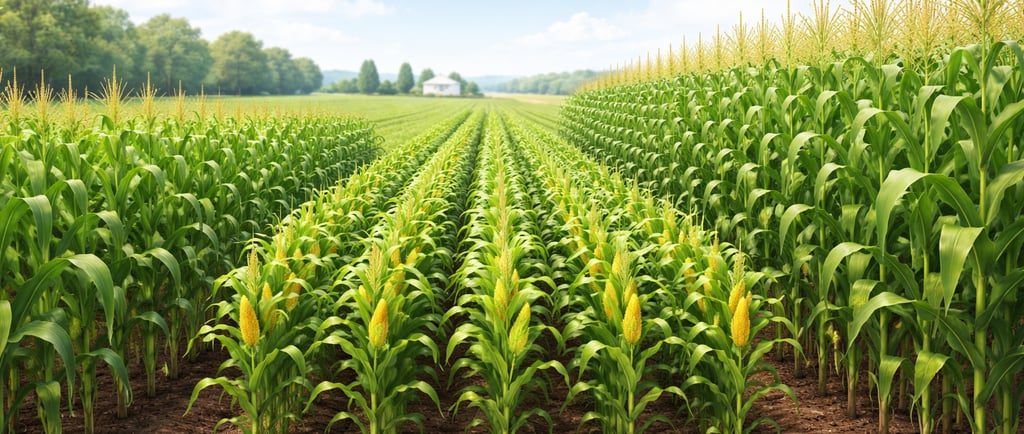
Understanding Single-Cross Hybrids
Grow Plant Well
Maize is one of the most widely grown crops in the world, and its productivity has increased significantly due to advances in hybrid breeding. Among the different types of maize hybrids, single-cross hybrids are the most commonly used in commercial agriculture because of their high yield potential, uniform growth, and reliable performance.
This blog explains how single-cross maize hybrids are developed and how high-quality hybrid seed is produced, in a way that is easy to understand for farmers, agronomists, and agriculture enthusiasts.
🌱 What Is a Single-Cross Maize Hybrid?
A single-cross maize hybrid is produced by crossing two genetically pure inbred lines. These inbred lines are developed through several generations of self-pollination until they become genetically uniform.
When two such inbred lines are crossed, the resulting hybrid shows hybrid vigour (heterosis), meaning it grows stronger and yields more than either parent. This is why single-cross hybrids are preferred for commercial maize production.
🌾 Development of Inbred Lines
The foundation of any successful maize hybrid lies in the quality of its parent lines. Inbred lines are developed by repeatedly self-pollinating selected plants over six to eight generations. During this process, plants are carefully evaluated and selected for important traits such as yield potential, disease resistance, stress tolerance, and flowering stability.
Only stable and uniform inbred lines are advanced for hybrid development.
🧪 Combining Ability and Hybrid Selection
Not all inbred lines perform well when crossed. Breeders test inbred lines through combining ability studies to identify which parental combinations produce superior hybrids. These studies measure how well a line performs across different crosses and environments.
Promising single-cross hybrids are then evaluated in multi-location trials to ensure consistent performance before they are released for commercial seed production.
🌽 Single-Cross Hybrid Seed Production
Producing hybrid maize seed requires strict field management to maintain genetic purity and seed quality.
Seed production fields must be isolated from other maize crops to prevent unwanted pollen contamination. The two parent lines are planted in specific row arrangements, with one serving as the female parent and the other as the male pollen donor.
Only seed produced on the female parent plants is harvested as hybrid seed.
✂️ Detasseling and Male Sterility
To prevent self-pollination in female plants, two main approaches are used:
Manual detasseling involves removing the tassels from female plants before pollen is shed. This ensures that all pollination comes from the male parent.
Cytoplasmic male sterility (CMS) is a genetic system where female plants naturally produce no pollen. CMS reduces labour costs and improves genetic purity and is widely used in modern commercial seed production.
⏱ Importance of Flowering Synchronisation
Successful hybrid seed production depends on proper timing. Male plants must shed pollen when female plants are producing receptive silks. If flowering is not synchronised, seed set will be poor and yields will decline.
To achieve synchronisation, seed producers may adjust planting dates or manage irrigation and nutrition carefully.
🌦 Crop Management During Seed Production
Good agronomic management is essential for producing high-quality seed. This includes balanced fertilisation, timely irrigation, weed control, and protection against pests and diseases. Stress during flowering can significantly reduce pollen viability and kernel development.
Maintaining healthy parent plants ensures strong pollination and uniform seed development.
🌽 Harvesting and Post-Harvest Handling
Hybrid maize seed is harvested when kernels reach physiological maturity. Only female parent plants are harvested, while male plants are removed or destroyed after pollination.
After harvest, seed is dried to safe moisture levels, cleaned, graded, and tested for quality. Germination percentage, purity, moisture content, and vigour are key parameters used to assess seed quality.
🏷 Quality Control and Certification
Before reaching farmers, hybrid seed must meet strict quality standards. Seed certification systems involve field inspections, laboratory testing, and documentation to ensure genetic purity and performance.
Certified single-cross hybrid seed gives farmers confidence in crop establishment and yield potential.
🌟 Why Single-Cross Hybrids Matter
Single-cross maize hybrids offer:
Higher and more stable yields
Uniform crop growth and maturity
Better tolerance to stress
Predictable performance in farmers’ fields
Although producing hybrid seed is more complex and costly, the benefits to farmers far outweigh the additional effort.
🌱 Final Thoughts – Grow Plant Well
At Grow Plant Well, we believe that strong crops begin with quality seed. Single-cross maize hybrids represent the most advanced and reliable form of hybrid maize, combining genetics, careful management, and scientific precision.
Understanding how hybrid seed is developed helps farmers make informed decisions and achieve better results in the field.