🌿 GROWPlantWell – Nurture Nature, Transform Your Space 🌿
APSIM Modelling How Virtual Farming Helps You Make Better Decisions
Learn how APSIM modelling helps farmers predict crop performance, choose better varieties and manage risk using simple virtual farm simulations.
Rashid Saleem
12/6/20253 min read
APSIM Modelling A Powerful Tool for Modern Agricultural Decision Making
Agriculture today is shaped by climate uncertainty, changing weather patterns, soil constraints and the increasing need to produce more while protecting natural resources. For farmers, researchers and advisors, making confident decisions requires more than field observations. It requires the ability to understand how crops respond to environmental conditions before those conditions occur.
This is where APSIM becomes invaluable. APSIM, the Agricultural Production Systems sIMulator, is one of the most respected crop and farming systems models used globally. It is designed to simulate crop growth, soil processes and management decisions under different climates, soils and farming systems. As a Research Agronomist working with field trials, hybrid evaluation and sustainable farming systems, I have seen the power of APSIM in turning complex questions into clear, evidence based insights.
What Is APSIM
APSIM is a process based simulation model that predicts how crops, soil and climate interact on a daily time step. It allows users to build virtual experiments using real climate data, detailed soil information and crop variety parameters. With APSIM, you can explore questions that would take years or even decades to test in the field.
APSIM is widely used for
understanding genotype by environment by management interactions
assessing the performance of climate resilient varieties and hybrids
optimising sowing dates, populations and fertiliser strategies
evaluating soil water and nitrogen dynamics
exploring climate change impacts
designing sustainable production systems
For research and on farm advisory work, APSIM offers a scientific and unbiased way to test multiple scenarios with speed and accuracy.
Why APSIM Matters for Varieties and Hybrids
One of the most practical uses of APSIM is in evaluating new crop genetics. Every variety or hybrid performs differently depending on water availability, temperature, soil type and management. APSIM allows you to represent those genetic differences through cultivar specific parameters such as phenology, radiation use efficiency, root depth and stress tolerance.
This makes APSIM a powerful partner in
screening varieties for drought and heat resilience
identifying hybrids with strong yield stability
mapping where a particular genotype performs best
reducing the cost and risk of large multi site trials
supporting breeders and agronomists with early insights
In my own research work, APSIM has helped guide decisions on sowing windows, planting density, hybrid performance in variable seasons and the suitability of new varieties for dryland conditions.
How APSIM Works
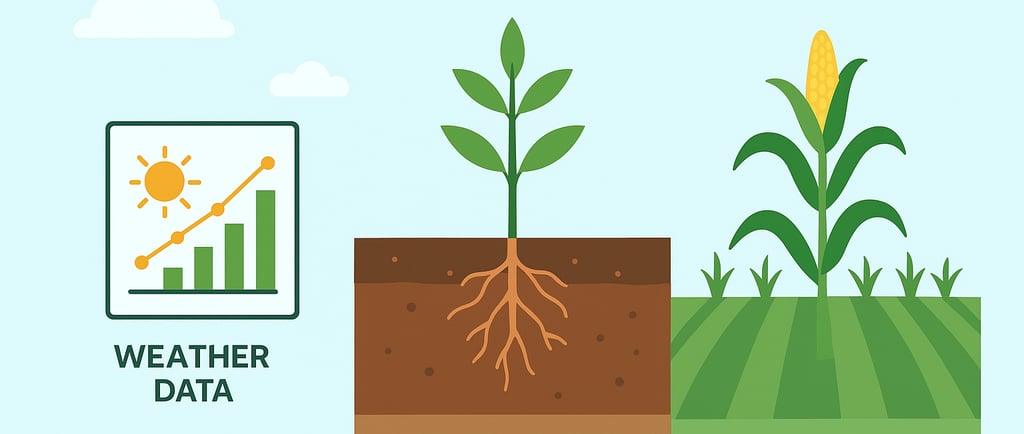
APSIM requires four main inputs
Weather data such as temperature, rainfall and solar radiation
Soil characteristics such as water holding capacity, texture and nitrogen
Crop type and cultivar parameters
Management details including sowing date, fertiliser, population and irrigation
Once these are entered, APSIM simulates daily processes such as
germination and emergence
leaf area development
biomass accumulation
root growth and water extraction
nitrogen uptake
stress responses
flowering and grain fill
final yield
It produces outputs like grain yield, biomass, soil moisture, nitrogen levels and stress indices that help researchers interpret the results.
APSIM in Sustainable Farming
Sustainability depends on knowing how a crop will behave under limited water, nutrient constraints or future climate conditions. APSIM supports this by
identifying water efficient varieties
understanding long term soil organic matter trends
designing rotations that build soil health
reducing input waste through optimised management
supporting carbon and nitrogen modelling
guiding drought preparedness and risk planning
When combined with climate resilient hybrids, soil health practices and precision agriculture, APSIM becomes a central tool for building resilient farming systems.
A Simple APSIM Workflow
Here is a typical workflow used in research and advisory settings
Build a soil profile for the site.
Import long term weather data.
Select or create the variety or hybrid parameter file.
Add sowing date, population and fertiliser strategy.
Run simulations across multiple years or climate scenarios.
Analyse outputs such as yield, water use and stress.
Compare genotypes and management options to identify the best strategy.
This workflow allows agronomists, breeders and farmers to make more informed and confident decisions.
The Future of APSIM
APSIM continues to evolve through APSIM NextGen, which is faster, more flexible and better suited for large scenario experiments. As agriculture becomes more data rich, APSIM is integrating with remote sensing, machine learning and decision support platforms.
For researchers and advisors, this opens new possibilities including
real time decision tools for farmers
automated genotype selection models
large scale climate adaptation assessments
improved modelling of pasture systems and mixed enterprises
The future of agronomy will rely heavily on digital tools, and APSIM is at the heart of that transformation.
Final Thoughts
APSIM is much more than a simulation model. It is a bridge between research and practical decision making. For farmers, it reduces risk. For breeders, it accelerates evaluation. For agronomists, it offers clarity in complex environments.
As climate conditions continue to challenge agriculture, tools like APSIM will be essential for designing resilient, efficient and sustainable production systems. With the right data and thoughtful interpretation, APSIM can guide farming decisions that remain profitable and environmentally responsible for years to come.